

Equipment Financing: The Secret to Scaling Your Operations in 2025

Have you ever considered how many sales you lose to non-flexible payment terms? If you sell expensive equipment or services, the chances of lost sales rise exponentially simply because your customers can’t afford to pay the whole sum at once.
Where do these lost clients go? In most cases, they strike deals with your competitors with flexible and affordable in-house financing options. If you’re targeting business growth and want to offer more flexible cash flow solutions, it’s time to think about introducing fast equipment loans for your customers.
In this article, we walk you through simplified in-house financing for your customers’ purchases with high upfront costs. We will show how modern loan origination software built for businesses like yours can help you with this move.
What Is Equipment Financing?
Equipment purchase financing is a vital aspect of small business growth and development. Startups often operate on limited budgets, so they can’t afford to spend a lump sum of money on expensive, modern equipment. Thus, they resort to equipment leasing, which means long-term rental on affordable conditions, or look for business equipment loans directly from equipment providers.
This way, for instance, a constructor can get an HVAC financing contract from an HVAC producer to equip its new building with HVAC systems and repay the loan within 12-36 months from the money earned on property rent or sales. A private medical business can get in-house financing for the purchase of clinical testing equipment or MRI scans and repay the cost of that equipment from revenue generated after the clinic’s launch. In each of these cases, businesses benefit from favorable lending terms and preserve their working business capital for smoother development.
Why Equipment Sellers and Contractors Need In-House Financing in 2025
In-house equipment financing has become one of the most valuable contractor business tools in 2025. Equipment sellers implement these solutions to:
- Avoid equipment purchase delays.
- Avoid missed opportunities.
- Enjoy faster sales.
- Raise customer satisfaction.
Equipment buyers also prefer this option to traditional bank loans because of:
- An ability to stay productive and competitive in the modern market with timely equipment upgrades.
- Winning bids for large-scale projects with modern equipment.
- Avoiding the risk of lost revenue due to the high maintenance costs of old equipment.
- Quick and affordable services of fast-track loan decision-making and origination.
What Are the Types of Equipment Financing?
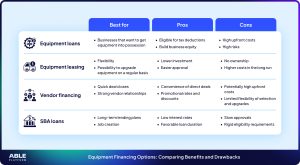
Equipment financing is not as straightforward as it seems. Two main paths to getting the necessary equipment at your disposal include equipment leasing and fast equipment loans. However, you may also get it with vendor financing and SBA loans. Here are the main differences between these types:
- Equipment loans. Businesses obtain the full price of the equipment from a bank or credit union and then pay the vendor. They repay the loan to the lender on the pre-negotiated terms and own the equipment, which serves as collateral for the loan. Equipment loans may range from $5,000 to $5,000,000, depending on the type of equipment needed, the company’s credit score, and the type of lender they choose.
- Equipment leasing. Leasing is a different arrangement that presupposes long-term equipment rent. Lease terms usually range from one year to five years, during which the user pays leasing fees; at the end of the leasing period, the user returns the equipment.
- Vendor financing. This is a form of in-house financing where the equipment vendor allows its buyers to repay the cost of the equipment in installments. Many suppliers offer promotional terms, such as zero interest rates for a certain grace period, to boost their sales volumes and build long-term customer relationships.
- SBA loans for equipment. Small Business Administration (SBA) issues long-term loans with favorable interest rates to support small business growth under its 7(a) and CDC/504 programs. It covers 75-85% of the equipment cost, making the process risk-free for both lenders and borrowers. However, applicants must meet a lengthy list of eligibility criteria to have this loan approved.
5 Signs You’re Ready to Offer Financing to Customers
So, how can you assess your business’s readiness for contractor loans? Here are the top 5 signs that will point to the need to launch a small business financing service.
- Your regular product/service ticket is $3,000+. The price tag for your products or services may be too high for some clients, thus resulting in missed sales.
- You lose deals because of high upfront costs. The lump sum that your clients need to pay upfront is too high to be accessible to your clients.
- You strive for faster sales cycles. You want to sell equipment faster to get funds for new rounds of equipment purchases from your wholesale suppliers.
- You don’t want to mess with third parties. Your clients complain about high equipment financing rates in banks and find them unaffordable.
- You’re in search of new growth channels. You want to make more sales to grow your business quicker.
What Are the Benefits of In-House Financing for Contractors?
Heavy machinery financing is a great option for most contractors because it gives them added operational and financial flexibility without quality compromises.
- Preservation of working capital. Companies can finance their operational needs and cover unexpected expenses because they don’t invest all their money in equipment purchases.
- Better competitiveness. Businesses become more competitive with cutting-edge equipment.
- Tax advantages. Many state initiatives cover equipment purchases (e.g., Section 179) to stimulate business development and modernization.
- Flexible repayment options. By offering flexible repayment terms, equipment providers can customize their solutions to the seasonal and project-based demands of their clients.
The good news is that ABLE Platform™ enables you to set up a loan origination system to meet all the needs of your clients. We offer competitive rates and personalized support, which can help you maximize these benefits without quality compromises.
Things to Consider Before Financing
Businesses that consider equipment financing usually go through the following decision-making checklist before implementing the new service:
- Business needs assessment. Will financing increase ROI?
- Evaluation of terms. What rates, fees, and repayment schedules do competitors currently offer?
- Leasing vs. purchase. Should the financing plan cover leasing or ownership programs?
- Credit impact. What minimal credit score should an applicant have to receive financing?
- Risk assessment. How quickly does our equipment get obsolete? What maintenance costs are involved?
If you’re in doubt about your equipment financing project, feel free to turn to ABLE™ for a free consultation. We will assess your business and give custom-tailored recommendations for maximizing the value and relevance of your in-house financing offers.
How to Launch In-House Equipment Financing with ABLE?
Now, let’s get to the practical side of setting up your loan management software and giving your clients access to in-house financing options. Before you open an in-house credit line to clients, what aspects do you need to consider?
Step 1: Analyze Your Sales Stats and Verify
Get down to the math to see whether in-house financing can indeed translate into greater ROI. If you see many missed sales attributable to high upfront costs, this solution may benefit your business.
Step 2: Assess the Regulatory Environment
Check all regulatory and licensing requirements in your jurisdiction to make sure you’re eligible for the in-house financing service provision. Otherwise, the cost of registration and licensing may be too high to pay off.
Step 3: Install ABLE Platform™ Loan Servicing System
Set up our commercial lending software and customize all financing terms, interest rates, and creditworthiness assessments to create your own branded financing offers.
Step 4: Enable Fully Digitized Application and Approval Channels
Integrate the in-house financing software into your broader architecture, enable digital document uploads and verification, and set up e-signature functions to allow fully digital loan application management.
Step 5: Offer Equipment Financing Options to Customers
Market the new financing feature across your business channels to let your clients know about this new option and invite them to try it out by submitting an application.
Why Choose ABLE Platform™ for Equipment Financing?
By choosing ABLE™ for your in-house loan programs, you can reap several sizable benefits, such as:
- Tailored solutions. Our platform offers full customization of financing plans, letting you match the offer to your industry specifics, average ticket, and business cash flow needs.
- Fast approvals. The application process gets fully streamlined and automated with ABLE™, enabling you to make decisions within 24 hours.
- Expert guidance. Our vetted lending experts and technical specialists will guide you through all the steps of setting up our in-house financing system.
- Competitive rates. ABLE™ offers affordable and transparent rates that won’t strain your budget.
These advantages make working with ABLE™ a rewarding, simple, and cost-effective solution for your business growth.
What Kind of Results Can You Expect?
The use of ABLE™ lending solutions is sure to trigger small business growth and give any equipment provider a robust market advantage by translating into:
- Higher closed deal rates (20-40% gains, depending on industry)
- Bigger deal sizes
- Higher customer loyalty
- Competitive advantage
- Better cash flow management
Conclusion
As you can see, equipment financing gives a solid impetus for small business growth without straining the budgets of promising startups. By partnering with the ABLE Platform™ loan origination system and removing financial barriers to modernization, you can grow your sales volumes and help many other businesses advance in their respective niches with modern equipment. Try our loan origination solutions today to open new doors to your business and dozens of your clients. Enjoy fully automated, accurate, and low-risk financing products to build a new name for your brand in the equipment business.
FAQ
