

How Much Does It Cost to Develop a Money Lending App?

Money loans have existed since time immemorial, and modern digitalization transforms this traditional sphere of financial services along with the entire finance sector. The world has witnessed the rise of many money lending platforms in the past couple of years, and the market is generally booming:
- In 2022, 78% of US adults reported using mobile apps, with only 29% of Americans preferring a personal visit to a bank.
- The digital lending market, which used to cost around $5.5 million in 2019, is expected to exceed $20 million by 2027.
The 2021 report by Financial Express showed that 40% of modern borrowers (mostly Millennials) prefer online lending resources to brick-and-mortar organizations.
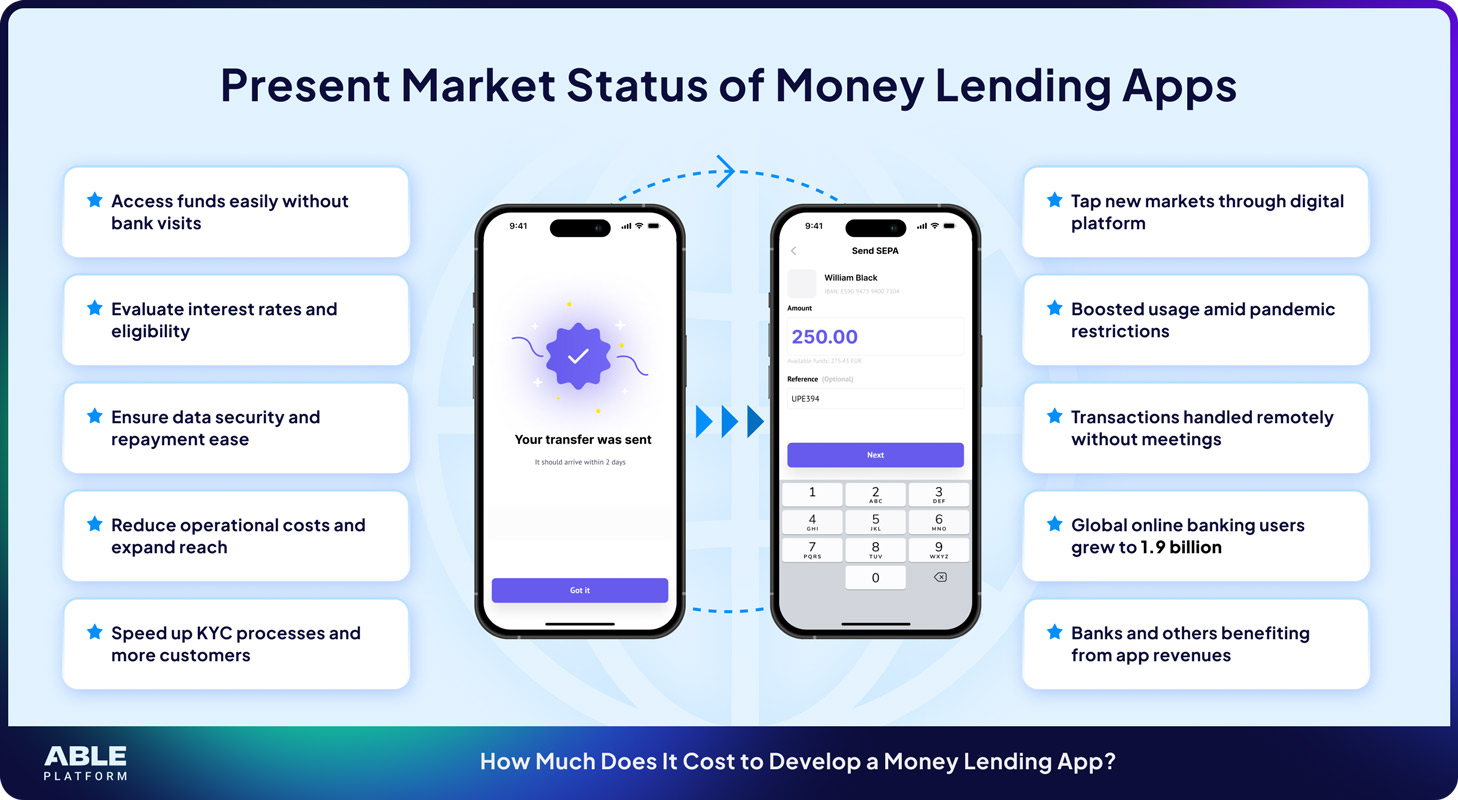
What’s more, the trend is expected to persist, with the humblest estimate of $46.5 million for 2030. What’s behind that fast growth and adoption?
- The COVID-19 pandemic stimulated digital service adoption because of lockdowns.
- The massive trend for blockchain and Web3 development, with new variants of money lending becoming accessible to users.
- The growing adoption of digital technologies in an increasingly interconnected world.
- The growing use of AI/ML in the digital banking sector makes online lending more accurate and smarter.
- The rising demand for digital channels of loan origination and disbursement, with faster approvals and quick decision-making.
All these factors combined have resulted in the online banking services’ increasing offerings of money lending features for their users. If you’re a financial business considering a money lending app, this guide will help you estimate the budget for this project. Here, we cover all the details of the cost breakdown and point to the factors you should keep in mind when choosing a software vendor.
Why Are Money Lending Apps in Demand?
The truth is that lending apps are gaining popularity both among digital banking businesses and end-users. The reasons for this rising interest are as follows.
Financial players reap:
- Better customer experience and satisfaction. By means of performing all operations in a user-friendly, intuitive app, customers enjoy fast and rewarding experiences. Therefore, their trust and loyalty grow.
- Omnichannel lending services. Businesses that expand their presence with digital and mobile lending features are sure to enjoy a wider market outreach. Therefore, they increase their customer base and service range for additional revenue streams.
- Operational cost reduction. It takes much fewer human resources to operate a digital lending business with a wide range of automation features.
- Loan lifecycle automation. Quicker loan application processing, fast loan origination, and other automated processes make digital lending much more manageable on the business side.
- Better risk management. The use of AI/ML technologies in creditworthiness assessment reduces the risk of bad loans and non-repayments.
Borrowers get:
- Personalized services. Digital apps are currently built with customization in mind, so users may enjoy hyper-personalized service offers, features, and layouts.
- Quick loan disbursal. Quick access to borrowed finance is a strategically important priority that users get with lending apps.
- Transparency and speed. Contemporary lending apps offer clear and transparent terms and conditions without hidden fees or shocking interest rates.
- 24/7 access to borrowed finance. Apps usually work around the clock, enabling users to apply for loans and get the requested money quickly disbursed at any moment of day or night.
- Flexibility in vendor selection. Users can choose among a wide variety of lending apps and businesses by comparing rates, eligibility criteria, and UI/UX nuances.
How Do Money Lending Apps Work?
In a nutshell, a money lending app is a type of mobile or web app that you can download to your device, register by providing relevant identity documentation, and access finance on the provider’s terms. Modern apps provide user-friendly user onboarding to welcome newbies and minimize the learning curve.
In most cases, you will have to integrate your bank account with the app or confirm your source of income to receive a personalized loan offer. The source of finance, type of lending offer, and interest rates differ from app to app and depend on the app types considered below.
Main Types of Money Lending Apps
- Consumer loan apps. This app type is meant for small cash advances that may help users address personal expenditure needs, such as unexpected travel expenses or medical bills.
- Payday loan apps. The principle behind using payday lending software is as follows: users register in the app and provide proof of their wages. The system calculates a convenient lending offer based on the user’s regular financial capacity and opens a short-term credit line for up to one month, with credit covered on the next payday.
- Peer-to-peer lending apps. The P2P app brings lenders and borrowers on a single platform, where they choose from each other’s offers based on the convenient sums of loans, interest rates, and other conditions. The app’s owner usually earns commissions from successful deals.
- Business loan apps. These apps are ideal for SMBs that need to finance business growth or address their day-to-day business needs. They typically offer business-friendly tools and offer greater latitude in repayment conditions.
- Student loan apps. These apps specialize in tuition financing or other forms of student support. The user has to provide a student ID to be eligible for student-specific terms and offers.
- Mortgage loan apps. Mortgage management gets way simpler with a modern, feature-rich app. It may be an external app provider or the app of the financial institution that provides the client’s mortgage.
- Auto loan apps. These apps are known for a fast application and approval process and match the needs of users planning a car purchase. Users can choose from several loan programs by comparing the duration and interest rate offerings.
- Microfinance apps. These apps are more popular in developing countries, as they suit the needs of people with small, short-term loan needs. They give more democratic access to finance for underbanked and unbanked populations but are notorious for high interest rates.
- Medical loan apps. These apps may be used to cover medical expenses. They often have broad partnership networks with medical providers in particular locations, thus allowing users to get discounts and cashback from medical product and service purchases.
Key Features of a Money Lending App
Here, we proceed to a more concrete breakdown of features for concrete loan types. Every money lending app should have a minimum of two platform components:
- Mobile app for users. This is the front-end part of the lending software that gives users access to your lending offers and a variety of related features.
- Admin platform. This is your “back office,” from which you conduct all administrative operations and management of user accounts, access tiers, and financial services.

At a minimum, your lending app should incorporate the following features:
- Registration and authentication. Users should have an opportunity to register in the app after its download and verify their identities to get access to all essential features.
- User profile management. Both users and admins should be able to configure the user profiles to enhance the app’s usability and personalization.
- Loan application. Lending apps should provide a seamless procedure for applying for a loan, with a clear breakdown of steps and data required from the applicant at each stage.
- Document upload and verification. Users should verify their identities and give proof of income to access loans. Thus, the app should have a secure and user-friendly document management function.
- Loan calculator. Every lender offers a variety of financial products to cover various lender categories. Therefore, the app should allow quick and transparent loan calculations to enhance informed decision-making.
- Credit score checking. The provider should be able to evaluate the applicant’s creditworthiness quickly and accurately, which is currently done by AI/ML algorithms and decision engines.
- Loan management. The loan should be adequately managed after disbursal, with repayment schedule and amortization calculations available to the client in their profiles.
- Notifications and alerts. The users should receive timely reminders and notifications about status changes and pending payments.
- Analytics and reporting. Modern FinTech apps are equipped with smart analytical tools that help users track their financial products and loans.
- Security and data privacy. Cybersecurity is key in digital banking and lending, so the app should be adequately protected and encrypted to keep user funds and data secure.
- Compliance and regulatory features. Though digital lending is not always about traditional banking, financial players also have to exhibit rigorous compliance with the laws and regulations in their jurisdictions of service coverage.
- Customer support. Users should enjoy timely and competent support 24/7, either with the help of human staff or with smart AI chatbots.
6 Successful Money Lending App Examples
Here are a couple of illustrative examples that may guide you in the process of choosing features and technologies to make a lending app.
- Prosper. This is a personal loans app built by a California-based company, Prosper Marketplace, Inc. It gives access to a broad number of features, such as custom-tailored personal loan offers, credit cards, home equity options, and financial education materials. Its integration features also allow users to manage existing loans via the company’s intuitive app alongside the financial products of Prosper.
- Dave. Dave is a lending app from Evolve Bank & Trust, an FDIC Member. The provider allows cash advances of up to $500 for users with an ExtraCash™ feature. The app allows immediate disbursals of cash advances without a credit check.
- EarnIn. This payday lending software transforms the process of salary disbursal and money use for its users. Counter to the regular arrangement of weekly, bi-weekly, or monthly payments, EarnIn allows its users to get daily payments for the work they have done. The system works as a cash advance calculated based on the user’s official salary; the app also provides free credit monitoring features to ensure that users utilize the cash advance opportunities wisely.
- Blend. This app product for financial businesses promises large-scale lending infrastructure optimizations and offers mortgage origination features, consumer banking, omnichannel lending functionality, etc. The Blend platform simplifies and automates loan origination and management pipelines for various kinds of lending businesses.
- Chime. Chime is a FinTech company, an FDIC member, and an online banking service with a variety of features. One of them is SpotMe, a cash advance arrangement that allows customers with a valid Chime Debit Card to get advance payments to their accounts, settling them with the next incoming deposit.
- MoneyLion. The personal finance app of MoneyLion FinTech supports personal loan offers of up to 100,000 and cash advances of up to $500 to users. Essentially, it gives borrowers access to the MoneyLion marketplace, where they can get personal loan offers from a variety of the company’s partners.
If you liked any of them and want to mimic their style and functionality, send references to the potential partners as you choose a vendor for this project. It’s important to find a developer who can create a similar software product and possesses vital expertise in this area.
How Much Does It Cost to Build a Loan Lending App?
The loan app development price depends on the app’s type (microfinance loan management software, business loans, payday loans, medical lending, etc.). Other factors that shape the cost include the app’s core functionality, customization, location, and several other aspects. Therefore, we’re giving only approximate estimates of the app’s cost as initial guidance in the budgeting process.
First, the cost varies by the location of your development team. Here is an average breakdown of hourly costs of the lending app development work in various regions:
- North America – from $50 to $125 per hour.
- Latin America – $15-$75 per hour.
- Eastern Europe – $20-$100 per hour.
- Western Europe – $50-$200 per hour.
- Asia – $10-$50 per hour.
- Australia – $40-$170 per hour.
Next, your cost estimate will depend on the technology you choose to build your app.
- Python, Java, and Ruby. These are highly popular programming languages in app development, with developers from Africa, Asia, and Eastern Europe working for $25-60 per hour on average, and programmers from Western Europe charging $50-150 for their services.
- JavaScript. Asian and African JavaScript experts are available for $15-40 per hour, and Eastern European programmers work for $20-50 per hour. Western European developers will cost you from $40 to $120+ on average.
- C#. A programmer from Western Europe typically charges from $50 to $150+ for C# programming services and PHP, while developers from Eastern Europe, Asia, and Africa are available at $20-$60 per hour. Latin American developers charge a bit higher rates, from $30 to $70 per hour.
The expertise of developers engaged in your project will also affect the budget, as senior-level programmers charge disproportionately more money than junior-level and mid-level developers. You should also take into account that various stages of app development require different experts and a different number of work hours. Thus, all these aspects have to be included in the app development budget. Let’s illustrate the cost breakdown by taking a medium hourly rate of $25.
| Discussion of requirements | 6-10 hours | $150-$250 |
| UI/UX Design | 120-160 hours | $3,000 – $4,000 |
| App development | 1,000+ hours | $25,000+ |
| QA and testing | 200-400 hours | $5,000 – $10,000 |
| Project management | Done simultaneously with other stages but requiring separate financial coverage for PM’s work | Around $5,000 |
To be more precise in terms of the “app development” stage, you may look at the following breakdown of features and the time required to create them:
- User registration and authorization – 100 hours.
- KYC procedures – 85 hours.
- User account settings – 70-80 hours.
- Payments/billing – 96 hours.
- Withdrawals – 100+ hours.
- Support system – 140-150 hours.
- Dashboard – 20-30 hours.
- Admin panel – 300 – 350 hours.
- Documentation system – 20-30 hours.
The final cost of your lending app will also depend on the app’s complexity, which also affects the duration of your development team’s work on it:
| Complexity | Simple | Medium | Complex |
| Price | $15,000 – $40,000+ | $40,000 – $100,000+ | $100,000 – $200,000+ |
| Duration | 1-3 months | 3-6 months | 6-12+ months |
How ABLE Can Save Costs and Optimize Your Time to Market
As soon as you begin to set your budget for loan app development, it makes sense to take a closer look at pre-configured, ready-to-use loan app solutions like the one by ABLE Platform. We offer several effective low-code lending software products, such as loan origination software and retail lending and microfinance software, to speed up, automate, and streamline the full loan management lifecycle across digital lending business sectors.
Still wondering why use low code for lending platform development? Visit the ABLE Platform’s website to see how the low-code solution can transform your users’ experience with lending apps. Our software product supports the full loan cycle, from loan application review to origination, management, and collection.
Conclusion
Here you go with everything you need to know about the cost to develop a loan lending app. Though the process of cost estimation may seem a bit confusing, it makes sense to approach it consistently to avoid unforeseen expenditures. Focus on the core functionality you expect to see in your app, discuss the technology stack with your provider, and make a choice between custom development or white-label lending software usage. In the second case, your loan app cost estimate is sure to be much lower. Look through the use cases and implementations for ABLE to see how it works in practice and make the final decision.
FAQ
