

The global lending market is changing fast, and the main driving force of that change is software automation. Thus, the choice of title loan software 2026 is not only a technology choice. It’s every lending business’s strategic decision that keeps firms moving forward.
What does the right loan origination software mean? Customers strive for faster approvals without the hassle of sending tons of documents or visiting the lender’s office. Regulators want clean, compliant processes and pose no operational bottlenecks to lending firms. Lenders must navigate these demands to survive and thrive, but it’s impossible with manual processes and fragmented IT infrastructures.
Digitalization is key for the massive US subprime auto loans industry, which grew to $19.3 billion in 2025. The tech shift influences subprime lenders and Buy Here Pay Here (BHPH) dealers the most. The BHPH segment of the U.S. used car sales market has exceeded 10% in 2025. With tight margins and ever-more demanding compliance, lenders have to become more efficient for survival. This is where automated title loan software comes in handy. With a CAGR of 7.9% for auto loan origination software, BHPH and subprime lenders should perceive this digital innovation as their key business priority in 2026.
This guide invites you to explore the best title loan software 2026 options, must-have features of an ideal software solution, and common blunders a lending firm should avoid in software selection. I also introduce the main software features that address subprime and BHPH lenders’ needs in the best way. Read to stay tuned to the trends that will share the title loan LOS market in the coming months.
Market Context: Lending in 2026
The discussion of the best title loan software would be incomplete without considering the market context in which lenders have to operate in 2026 and beyond. The first factor all lenders should always keep in sight is the mounting regulatory pressure. Legal scrutiny rises because of the combined effect of tightening consumer protection laws and the regulators’ efforts to address emerging technology risks.
This way, the U.S. subprime lending market is heavily affected by the federal-level Equal Credit Opportunity Act (ECOA), mandating fair lending decisions and transparency of terms. Another milestone law is the Truth in Lending Act (TILA), which also regulates non-discriminatory lending. The U.S. Consumer Financial Protection Bureau (CFPB) oversees all lenders’ operations and issues new rules and guidance to firms. Several legal reforms are underway to regulate automated credit engines in response to the rising use of AI judgment.
The European regulatory environment for subprime lending includes a patchwork of consumer protection laws, responsible lending regulations, and the EU-wide Artificial Intelligence Act. The latter addresses the explainability of AI-powered credit scoring software to ensure fair borrower treatment and transparency of loan terms. Thus, lenders need to factor all relevant regulatory issues into their title loan software 2026 to avoid fines or litigation.
The second factor shaping the market is the evolution of consumer expectations. The present-day consumer of digital lending services wants convenience, speed, and accuracy, coupled with quick and informative communication. Positive user experiences are associated with instant underwriting decisions and clear disclosures of costs and terms, making the entire loan application lifecycle frictionless and borrower-friendly. Thus, a lender’s inability to guarantee direct, functional integrations with users’ preferred tools and devices makes young, digital-savvy users leave.
The third factor that can’t be ignored is the rise of AI use in title loan software 2026. Businesses adopt AI-powered credit risk assessment tools, fraud detection algorithms, predictive models, and ML solutions to leverage dynamic loan pricing and personalization of terms. These solutions serve the strategic goal of issuing more loans and growing the lending firm’s clientele without engaging in excess risk. However, such systems often act as black boxes, and regulatory institutions push lenders to disclose the decision-making structure of their AI tools to guarantee the absence of discrimination.
This combination of factors has serious implications for lenders in 2026. They have to balance efficiency with transparency, guaranteeing that automation doesn’t marginalize certain applicant categories. This intricate fusion of risk modeling and legality is an important dimension in title loan software 2026 selection.
Must-Have Features in 2026 Title Loan Software
What turns the best subprime lending platforms 2025 into market leaders? Here are some must-have features that any new title pawn software assessment should include.
Loan origination automation
The main benefit of contemporary auto title loan software solutions is the speed and consistency of automated workflows. Previously, dealers had to input all data manually. Borrower data, vehicle information, lien status, and all relevant documents had to be pulled together, which took days to complete the deal. LOS platforms change things by uniting all these tasks into a single, automated workflow. The features that let such systems automate origination include:
- Digital document uploads
- Automated KYC
- E-signature
- Instant disclosure of credit decision and terms.
As a result of automation at this stage, the lender brings down operational costs and human error risks, while borrowers get near-instant loan decisions.
AI-powered underwriting
AI use in underwriting is also gaining traction in lending. AI algorithms include more applicant data sources in the risk assessment and rely on fuzzy data that skips the gaze of traditional loan origination systems. They look at:
- Past payment behavior and patterns of borrowers.
- Vehicle value trends.
- The applicant’s income stability.
However, AI-powered credit risk assessment is currently a source of risk and opportunity for lenders. While automation increases the accuracy of loan decisions, lenders are legally obliged to justify their decisions, which means combining AI with human oversight.
Risk-based pricing tools
Static loan pricing is not sensitive to versatile applicant profiles, different loan products, and the increasing market volatility. That’s why lenders choose title loan software 2026 with risk-based, dynamic pricing tools like:
- Dynamic APR adjustment.
- Loan size adjustment.
- Pricing variation based on the borrower’s risk profile.
- Collateral value assessment.
- Regulatory risk assessment.
Such a nuanced analysis gives a competitive loan offer without compliance risks and profit margin compromises.
Repossession management
Nobody wants to think about repossession at the moment of striking a loan deal. Yet, this negative outcome is still a strong possibility for many high-risk lenders. This is how modern buy here pay here software solutions address this sensitive issue.
- Delinquency risks are continually tracked per loan user, with alerts issued at the moment when the risk level exceeds a certain threshold.
- Vehicle recovery status is monitored within the centralized repossession workflow.
- Fees and timelines are updated in real time to give both the borrower and the lender adequate assessment of the situation.
- Repossession procedures are continually monitored for compliance, thus reducing the lender’s risk of lawsuits for unlawful repossession.
Dealer portal / CRM
An admin-friendly dealer CRM gives lenders a central portal for real-time loan inventory tracking, application status control, and communication with customers. A future-proof CRM of car title loan software should support:
- Borrower follow-ups
- Payment reminder notifications (SMS, push notifications, or messenger alerts)
- Self-service functionality
- Customer retention tools.
CFPB-ready compliance monitoring
With the CFPB governing all subprime lending in the USA, lenders can’t afford to ignore the legal auditability aspect in their design and setup of title loan software 2026. The LOS system used in 2026 and beyond should already be built around CFPB rules, withstanding audit trails and ensuring compliance of every routine operation. This degree of compliance readiness is achieved by means of:
- Automated compliance risk alerts.
- Reporting dashboards.
- Compliance documentation.
- Fair lending checks and disclosures.
How BHPH and Subprime Lenders Use Software Differently
Borrowers often treat BHPH and subprime lending as a single lender firm category. Indeed, their borrower audience often overlaps. Still, the technical requirements for BHPH and subprime auto lending software may differ because of the slight differences in their usage. Here are the main distinctions you should know.
- Business model. Subprime lenders most frequently specialize in standalone lending, while BHPH providers sell vehicles via in-house financing.
- Inventory management. Subprime lending requires minimal inventory management, but for BHPH firms, these software tools are central. These firms track vehicle inventory, availability, and pricing continually, thus prioritizing this feature in software selection.
- Deal structuring. Loan terms in subprime lending are generated individually in response to the application. BHPH lenders structure the deal at the sales desk, with all terms and repayment conditions discussed with the buyer in real time.
- POS integration. Subprime lenders typically don’t use POSs and rely on digital channels only. BHPH lenders rely on strong POS and dealership networks.
- Application processing. Subprime lenders process applications and issue the verdict online, while BHPH lenders negotiate the deal with applicants in person.
- Relevant compliance requirements. Subprime lenders face robust CFPB oversight and have to comply with consumer laws and fair lending regulations. BHPH dealers have to focus their compliance efforts on retail instalment contract laws, lawful repossession procedures, and motor vehicle laws.
Each of these factors affects the choice of title loan software 2026 and its customization to a specific business’s needs and workflows. BHPH dealers value unified sales tools and inventory management in a single LOS portal, while subprime lenders need scalable loan processing capabilities and robust compliance tools.
Common Mistakes When Choosing Software
Besides ignoring the software specifics of subprime versus BHPH dealer needs, lending firms often commit other mistakes with software selection. You should beware of these blunders because they reduce the value you get for your investment and result in a mismatch between the software system’s features and your daily automation needs.
Picking legacy providers
Tech progress is in full swing, but the market is still packed with legacy software providers. These systems are long-standing and quite famous in the lending software industry, but their technical solutions grow more outdated day by day. By choosing such software, lenders obtain rigid software platforms with limited scalability and customization. These options are short-lived, and the risk is very high that you will need to switch the provider and go through the entire fuss of software integration in a couple of years, if not months.
How to spot a legacy provider in the loan origination software market? These red flags can guide your assessment:
- Providers offer only on-premises or locally installed software without the flexibility of cloud-native solutions.
- Limited choice of API integrations.
- Manual updates require the provider’s tech team’s support.
- Slow and irregular releases of new versions.
- Significant system downtime during upgrades.
- Weak automation of workflows.
- Absence of advanced AI tools and data analytics.
- Outdated user interfaces.
Each of these characteristics should caution you against choosing the provider, as such systems have limited relevance and will soon become fully obsolete in the face of flexibility, customization, and rich API integrations of modern cloud-native software products.
Overpaying for unused features
When you’re searching for outstanding title loan software 2026, the temptation is very high to choose the one with the largest number of fancy features. Many platforms are marketed as comprehensive software with hundreds of modules, but the reality check shows that most clients never use even half of them. What features are not worth the extra pay? As a rule, these hidden costs come from:
- Fancy marketing automation funnels. You won’t need them if you have separate customer acquisition channels that work well and are not connected with the loan servicing ecosystem.
- Enterprise-level analytics. As a rule, such systems give real value if you have an in-house team of well-trained analysts who can make sense of that data and apply it in real business decisions.
- International lending modules with complex compliance logic. Those who operate domestically and don’t plan international expansion will never use these modules.
These and many other seemingly cool but factually redundant features will only increase your licensing fees and delay the system’s deployment. Thus, the choice of effective and relevant software features includes a detailed, honest analysis of your current business needs.
Ignoring compliance gaps
Compliance can’t be treated post factum in the modern subprime lending environment. That’s why many future-proof software products already incorporate compliance as their core system requirement. Waiting for external audits to uncover compliance gaps is very short-sighted; it may kill your firm before you rectify the compliance layer. That’s why I don’t recommend working with platforms that:
- Don’t implement TILA disclosures.
- Lack audit trails for AI decisions and underwriting.
- Offer little guidance on jurisdiction-specific caps, fees, and repossession procedures.
- Don’t include CFPB-format reports.
- Have no compliance trackers.
Such platforms lack the needed compliance insights a firm should use in everyday operations. Thus, the risks of fines and reputational damage are too high.
ABLE Platform: Future-Ready Lending Software
With all the risks and blunders of existing systems in mind, I can confidently recommend taking a closer look at our white-label ABLE™ platform that represents next-gen loan origination software with many competitive benefits. What makes it stand out and outperform rival software products?
- Modular, scalable architecture. The low-code framework of ABLE™ supports endless customization of every loan servicing dimension. The microservices approach makes the system scalable and adjustable, with your vision guiding the final platform design.
- End-to-end automation. AI and ML elements of process automation speed up decisions, application processing, and all other processes. Without manual work involved, ABLE™ can give a credit decision within seconds.
- Dealer- and lender-friendly design. Intuitive UI with a low-code rule composer makes dashboard customization and navigation simpler, with instant feedback provided. This way, our clients don’t require tech teams to launch such platforms and operate them.
Advanced compliance engine. ABLE™ comes with compliance-ready automation that makes your firm’s regulatory adherence a breeze. Our system is not reactive, with audit trails and real-time compliance adjustments ensuring regulatory compliance in every step.
Vendor Evaluation Checklist
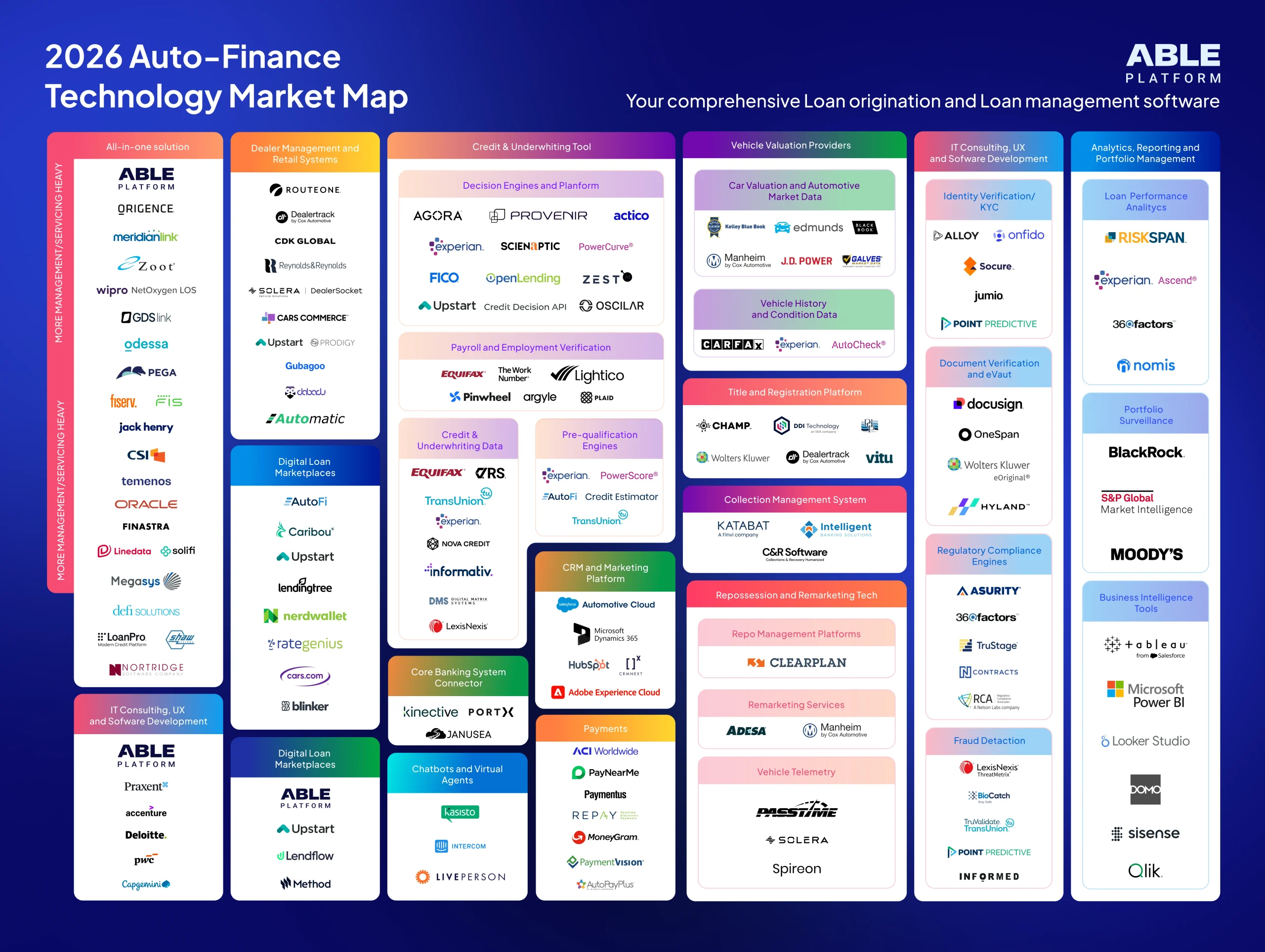
Now that you have a list of loan origination systems, how can you make an informed decision on which one to choose? The title loan software market is pretty saturated today, with tough competition and plenty of service providers competing for every client. Thus, you may need to do your due diligence and scan every option using this evaluation checklist.
Feature checklist
Following my ideas on the feature set above, you can define your own checklist for the features you really need. The most important title loan software elements that should always be present are:
- End-to-end loan servicing engine.
- AI-assisted underwriting with explainable logic.
- Risk-based, dynamic pricing.
- Automated fee calculator.
- Flexible payment scheduling.
- Dealer-friendly CRM.
- Real-time reporting and loan portfolio dashboard.
- Role-based access control.
- Compliant repossession workflows.
The rest should be chosen based on your business’s individual needs and performance targets.
Support considerations
The vendor’s support makes or breaks your user experience. It’s better to partner with software providers that have dedicated implementation teams, channels for client support and troubleshooting, ongoing training for your staff, and regular platform updates. It’s also vital that your vendor has in-depth compliance expertise relevant to your jurisdiction.
Integrations
Adaptive and compliant loan origination software thrives on API integrations, which help users build service ecosystems around core tools. Thus, your ideal software platform should enable connectivity to credit bureaus, various payment processors, title verification services, CRMs of your choice, and other open APIs for ecosystem expansion.
Compliance certifications
A safe vendor choice comes with proven compliance certificates relevant to your jurisdiction. For U.S. subprime lenders, the following certifications are a mandatory minimum:
- TILA, ECOA, and CFPB-compliant reporting.
- State-specific regulations on subprime lending fees, rates, and disclosure rules.
- SOC 2 and ISO 27001 data security standards
- AI governance and logic controls
- Audit trails for external checks.
Conclusion
As the lending market continues to grow, with solid business prospects in 2026 and beyond, choosing a feature-rich, safe, and compliant software platform is a must. Best-in-class software should enable automation and integrate the gains of AI technology to cut processing time, boost team productivity, and reduce errors while improving risk monitoring. Customer satisfaction is also heavily tech-dependent today, with fast technological advancements making lending service users more demanding in terms of speed, accuracy, and convenience.
If you’re looking for tried and tested title loan origination software, ABLE Platform™ can address all your business needs. The combination of modular architecture and advanced workflow automation makes it simple and convenient for both the lender and the borrower. Advanced compliance monitoring ensures your business is safe from penalties or litigation, thus creating a predictable, low-risk title loan service delivery environment. Check the features and customization opportunities of ABLE Platform™ to enjoy ease of integration and solid performance gains in 2026.
FAQ on Title Loan Software in 2026

