

The Role of the U.S. Small Business Administration in SME Lending

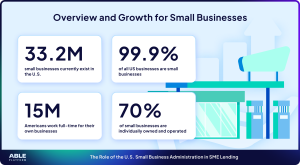
Small businesses are the bloodstream of the U.S. economy. Over 33 million SMEs in the USA give jobs to 61+ million Americans. Yet, according to the Bureau of Labor Statistics, over 24% of startups fail in their first year, with 48% of SMEs failing over the 5-year period.
That’s why support for U.S. small and medium-sized enterprises (SMEs) has become a matter of federal importance. One of the effective tools for access to finance among SMEs is the U.S. Small Business Administration (SBA) — an independent federal agency aimed at small business support.
SBA helps small businesses get funding, provides education for entrepreneurs, and links finance seekers with interested lenders. Here is a review of the SBA loan benefits for lenders and borrowers, the principles of SBA operations, and a unique business opportunity to expand the service range and increase customer outreach by becoming an SBA partner for lending businesses. We also introduce the ABLE™ SME lending software as a tried and tested option for gaining a competitive advantage in the lending market.
Understanding the SME Lending Landscape in the U.S.
The lending market landscape continues to be dominated by small firms and enterprises. The recent SBA statistics reveal $410 billion in loans to small firms below $1 million; the size of outstanding consumer loans to small enterprises has exceeded $4 trillion thus far. Yet, the present-day unmet credit demand stands at $100+ billion, with many traditional banks reluctant to issue small loans to SMEs.
This is where new market players, such as FinTech firms, digital lending providers, and P2P lending platforms, come into play. The market size of digital lending only exceeded $2.1 billion in revenue in 2023, with the 2030 revenue forecast currently standing at over $10.4 billion. These tempos give us a growth rate of 25%+, which shows the rapid expansion of lending solutions’ use and popularity in the U.S.
These tech-savvy lending providers can play a key role in SME lending by partnering with borrowers via the SBA accreditation system. The market for SME financing offers incredible business opportunities, and this article examines the nuances of SBA small business loan servicing as a viable business idea for 2025.
What Is the U.S. Small Business Administration and Its Role for SMEs
SBA was founded in 1953 to protect the interests of small business owners across multiple aspects. Its creation was the culmination of almost two decades of the U.S. economy’s recovery from the Great Depression, which badly affected or destroyed thousands of SMEs. SBA formalized several pathways for federal support of small businesses in the U.S., including:
- Access to capital for businesses that have exhausted other financing options or qualify as non-eligible for traditional financing.
- Provision of government contracting opportunities in various areas.
- SME owner counseling and training on the key aspects of successful entrepreneurship.
- Advocacy for the SMEs’ interests in federal legislation and policymaking.
- Disaster recovery assistance to SMEs and disaster preparedness support.
How the SBA Assists SME Lenders
The main benefit of SBA’s operations for SMEs is its provision of alternative sources for accessing finance to stimulate SME-led economic development. The agency is focused on supporting SME survival and expansion because of the critical role of small business in job creation and the spread of innovation in the U.S. That’s why SBA has developed a number of loan guarantee programs of enormous value to:
- Underrepresented groups (e.g., minorities, veterans).
- Homeowners and renters recovering from natural disasters and emergencies.
- Beginner entrepreneurs requiring mentorship and financial/marketing training.
The meaning of a loan guarantee is that these are government-backed loans. That’s why the risk for lenders is lower. The U.S. government will repay an estimated portion of the loan in case the borrower is unable to do so.
SBA’s support services are customized to various stages of a business lifecycle. Thus, a business owner can get essential help at the moment of launching a startup or when planning a market expansion.
SBA’s Main Types of Loans

The core role of SBA is to provide access to capital for small businesses that have exhausted other borrowing opportunities or have no access to them. Borrowers may choose from the three main types of SBA loans that match various business purposes:
- 7(a) loans – the most common and flexible type of SBA small business loan. It covers loans from $500,000 to $5 million and may be used as the firm’s working capital, debt refinancing tool, or financial support in the purchase of inventory.
- 504 loans – long-term, fixed-rate SBA loans in the U.S. specifically meant for fixed asset acquisition (e.g., equipment, land for commercial use, or real estate) by SBA Certified Development Companies.
- Microloans—These loans are capped at $50,000 and can be used as short-term business financing options for buying furniture, fixtures, supplies, materials, or equipment.
Our next article outlines all of these SBA loan types, including their details, lender and borrower requirements, and financial specifications.
Pros and Cons of Borrowing from the SBA
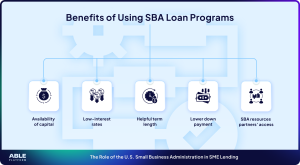
SBA financing is more accessible and flexible for small businesses. However, it also comes with specific downsides that an owner should weigh before applying for one of the SBA loan programs. Let’s take a closer look at the SBA loan advantages and disadvantages for borrowers.
Pros
The list of the key benefits of SBA loans is as follows:
- SBA loans come with competitive interest rates and more favorable repayment terms.
- Even businesses that don’t qualify for traditional loans can get an SBA loan.
- Long-term financing options are available.
- SBA provides education, business support, and mentorship resources.
- Funds can be used for many business purposes (working capital, real estate purchases and renovations, debt refinancing, supply and furniture purchases, etc.).
Cons
The downsides of opting for an SBA business loan include:
- Borrowers are typically required to make a down payment.
- Collateral is needed in some cases.
- Borrowers bear personal liability for business failure and non-repayment.
- The approval process is sometimes slow.
- Imposed prepayment penalties.
- Startups and applicants with poor credit scores may still be rejected.
Benefits of Becoming an SBA Partner for Lenders
Any lending business in the U.S. can apply to become an SBA lending partner. This partnership comes with many advantages for lenders:
- Access to a broader qualified borrower base.
- Reduced risk of non-repayment due to government-backed loan guarantees.
- Access to government incentives.
If you’re interested in this option, you may qualify as a Certified Lender Program (CLP) or Preferred Lender Program (PLP) participant. The main difference between these two categories is that CLPs are also authorized to service SBA loans, but their decisions also have to go through the SBA loan application process. So, it takes longer to get the loan disbursed because of the CLP and the SBA approval stages. PLPs can disburse loans without waiting for the SBA approval, so the process is generally faster. Yet, even CLPs make loans accessible within a shorter period compared to non-preferred and non-certified lenders working with SBA.
What Is the Difference between SBA Loans and Traditional Bank Loans?
Most SMEs face the need to consider traditional bank loans vs. SBA loans in the process of seeking finance for their business operations. Here is the chart describing the main differences between these two financial options.
| Traditional loan | SBA loan | |
| Loan structure | Loans are fully funded by the bank or lending institution, with the lender carrying all the risk of non-repayment. | SBA doesn’t lend money on its own; it partners with accredited lenders to provide a portion of the loan. This way, lenders have more solid protections against non-repayment and risk a smaller sum. |
| Accessibility | To get a loan SMEs need a strong credit score, collateral, and an impressive financial record. | A lower credit score requirement. Even SMEs with a limited credit history can qualify. |
| Loan duration | 3–10 years for repayment. | 10 years for working capital, 25 years for real estate, up to 6 years for microloans. |
| Interest rates | Higher interest rates, especially for risky borrowers. | Low interest rates (often pegged to the prime rate). |
| Servicing fees | Origination and early repayment fees may be included. | Guarantee and servicing fees. |
How Lending Market Players Can Streamline SBA Partnership with the ABLE™ Platform
Apart from the SBA approval badge, lending businesses can gain a greater competitive advantage in this growing, lucrative market niche by implementing robust, efficient SBA loan software for end-to-end automated loan underwriting. Our software can help any lender boost their business KPIs and efficiency, reduce delinquency rates, and improve the company’s overall financial health.
The ABLE™ Platform is a provider of safe, feature-rich small business loan origination software that can transform all aspects of your lending and loan servicing operations. Its unique competitive advantages in the market for SBA loan software include:
- from 30 to 300% increase in productivity.
- Short time to market (1–3 months).
- Implementation of credit risk monitoring.
- A 10–30 seconds turnaround for the loan application decision.
Due to these features and the speed of implementation, ABLE™ can be justly regarded as one of the best loan origination software for small business.
Conclusion
Small business is the most important and the most vulnerable part of the U.S. economy. With the digital lending industry experiencing unprecedented growth and digital transformation today, you can also supercharge your lending business by exploring automation solutions and stepping on the SBA partnership path.
The use of SBA loan servicing software, such as that supplied by ABLE™, will speed up and automate all stages of lending. Our solution simplifies lending decisions and operations by reducing bad debt risks and improving borrower satisfaction. Thus, it’s your optimal option to enter the SBA partner list with safe, transparent, and fast lending services.
FAQ
