Category
Digital lending is on the rise, with millions of people enjoying the flexibility and convenience of financial services. Yet, loan origination still remains the main bottleneck of the lending cycle,
Digital lending is on the rise, with millions of people enjoying the flexibility and convenience of financial services. Yet, loan origination still remains the main bottleneck of the lending cycle,

Have you ever considered how many sales you lose to non-flexible payment terms? If you sell expensive equipment or services, the chances of lost sales rise exponentially simply because your customers can’t afford to pay the whole sum at once.
Where do these lost clients go? In most cases, they strike deals with your competitors with flexible and affordable in-house financing options. If you’re targeting business growth and want to offer more flexible cash flow solutions, it’s time to think about introducing fast equipment loans for your customers.
In this article, we walk you through simplified in-house financing for your customers’ purchases with high upfront costs. We will show how modern loan origination software built for businesses like yours can help you with this move.
Equipment purchase financing is a vital aspect of small business growth and development. Startups often operate on limited budgets, so they can’t afford to spend a lump sum of money on expensive, modern equipment. Thus, they resort to equipment leasing, which means long-term rental on affordable conditions, or look for business equipment loans directly from equipment providers.
This way, for instance, a constructor can get an HVAC financing contract from an HVAC producer to equip its new building with HVAC systems and repay the loan within 12-36 months from the money earned on property rent or sales. A private medical business can get in-house financing for the purchase of clinical testing equipment or MRI scans and repay the cost of that equipment from revenue generated after the clinic’s launch. In each of these cases, businesses benefit from favorable lending terms and preserve their working business capital for smoother development.
In-house equipment financing has become one of the most valuable contractor business tools in 2025. Equipment sellers implement these solutions to:
Equipment buyers also prefer this option to traditional bank loans because of:
Equipment financing is not as straightforward as it seems. Two main paths to getting the necessary equipment at your disposal include equipment leasing and fast equipment loans. However, you may also get it with vendor financing and SBA loans. Here are the main differences between these types:
So, how can you assess your business’s readiness for contractor loans? Here are the top 5 signs that will point to the need to launch a small business financing service.
Heavy machinery financing is a great option for most contractors because it gives them added operational and financial flexibility without quality compromises.
The good news is that ABLE Platform™ enables you to set up a loan origination system to meet all the needs of your clients. We offer competitive rates and personalized support, which can help you maximize these benefits without quality compromises.
Businesses that consider equipment financing usually go through the following decision-making checklist before implementing the new service:
If you’re in doubt about your equipment financing project, feel free to turn to ABLE™ for a free consultation. We will assess your business and give custom-tailored recommendations for maximizing the value and relevance of your in-house financing offers.
Now, let’s get to the practical side of setting up your loan management software and giving your clients access to in-house financing options. Before you open an in-house credit line to clients, what aspects do you need to consider?
Get down to the math to see whether in-house financing can indeed translate into greater ROI. If you see many missed sales attributable to high upfront costs, this solution may benefit your business.
Check all regulatory and licensing requirements in your jurisdiction to make sure you’re eligible for the in-house financing service provision. Otherwise, the cost of registration and licensing may be too high to pay off.
Set up our commercial lending software and customize all financing terms, interest rates, and creditworthiness assessments to create your own branded financing offers.
Integrate the in-house financing software into your broader architecture, enable digital document uploads and verification, and set up e-signature functions to allow fully digital loan application management.
Market the new financing feature across your business channels to let your clients know about this new option and invite them to try it out by submitting an application.
By choosing ABLE™ for your in-house loan programs, you can reap several sizable benefits, such as:
These advantages make working with ABLE™ a rewarding, simple, and cost-effective solution for your business growth.
The use of ABLE™ lending solutions is sure to trigger small business growth and give any equipment provider a robust market advantage by translating into:
As you can see, equipment financing gives a solid impetus for small business growth without straining the budgets of promising startups. By partnering with the ABLE Platform™ loan origination system and removing financial barriers to modernization, you can grow your sales volumes and help many other businesses advance in their respective niches with modern equipment. Try our loan origination solutions today to open new doors to your business and dozens of your clients. Enjoy fully automated, accurate, and low-risk financing products to build a new name for your brand in the equipment business.

We’ve already dealt with SBA loans in our previous article. Here, we’re returning to this topic to dive deeper into the three main types of SBA loans, the existing categories of SBA lending programs, and the nuances of borrower application screening. The latter point is vitally important for the design and selection of SME lending software, which should include all SBA-approved parameters for creditworthiness review and decision-making.
It’s hard to overestimate the role of SBA loans in the U.S. because they give access to finance to small and mid-sized businesses lacking traditional financing options. The Small Business Administration (SBA) is a federal agency that links such businesses with approved lenders to stimulate the development of SMBs, the bloodstream of the American economy.
This way, by joining the list of approved SBA lenders, any business can expand its customer base, improve its rating and trust, and get access to exclusive government-sponsored programs and privileges.
This guide will walk you through all SBA loan options and requirements to inform your SBA loan software selection and application process. ABLE Platform™ is also ready to become your trusted provider of automated loan underwriting solutions to simplify your entry into the SBA lending industry.

Here is a detailed breakdown of each SBA small business loan program, with eligibility and documentation requirements.
Borrowers can apply for one of the several 7(a) loan options depending on the business purpose:
The SBA 504 loan program is meant to provide long-term financing to businesses for purchases of equipment, land, or commercial real estate. SBA 504 loan rates are fixed to relieve the burden of debt and give predictability in loan repayment to businesses.
This financing option is available only to borrowers applying via SBA Certified Development Companies with a clear, transparent mission statement and a community focus on business operations. The loan may cover up to $5.5 million per project, with a duration from 10 to 25 years.
As a rule, the structure of 504 loans is as follows: 50% is given out by a private lender, 40% is covered by the CDC, and the remaining 10% comes from the borrower’s down payment. The documents required from the borrower include:
A microloan is capped at $50,000; it may be issued to a startup, SME, or non-profit childcare provider. The microloan may be used as working capital or finance inventory, equipment, or supplies purchases. Compared to 7(a) and 504 loans given for 10-25 years, a microloan repayment period can’t exceed 6 years, with the interest rate ranging from 8% to 13%.
The scheme of microloan disbursal works a bit differently compared to 7(a) and 504 loans. These loans are allocated by SBA and issued by certified intermediary lenders who oversee the process of loan servicing. Documents required from a borrower include:
Separate categories within the microloan type of SBA-supported loans are disaster assistance and community advantage loan programs. The former assist applicants to recover from natural disasters and economic crises, while the latter are specifically targeted at underserved, disadvantaged communities.
SBA lenders use the E-Tran platform for a unified review of loan applications. It enables fast and compliant submission, review, and tracking of all SBA loan applications, thus ensuring faster loan approval via extensive automation. Lenders can join the E-Tran system to screen applicants for eligibility, upload and store related documents, and track the application’s progress in real-time.
So, how to get an SBA loan if you’re a small business in the U.S.? How to be approved by the SBA as an authorized lender? Here are the main SBA loan requirements for both sides of the lending process.
To reap the benefits of SBA loans, borrowers have to comply with a certain set of parameters for every SBA lending program type.
7(a) loan eligibility requirements are:
In addition, various SBA partnering lenders set specific requirements for borrowers in terms of the minimum number of years in business, their credit score, and annual revenue estimates. Thus, it makes sense to do some research on the eligibility criteria before applying.
The SBA 504 loan requirements include:
The requirements for participation in the SBA microloan program are:
Lending businesses wishing to become SBA partners also have to meet specific requirements for every loan category. The 7(a) loan eligibility criteria are:
There are some differences in lender qualifications for the SBA 504 loan vs 7a loan provision. Lenders should comply with the following criteria:
There are some differences in lender qualifications for the SBA 504 loan vs 7a loan provision. Lenders should comply with the following criteria:
Microloans are primarily allocated by the SBA and issued to the public with the help of intermediary lenders. To become one, you need to meet the following parameters:
The main goal of choosing efficient and robust SBA loan servicing software is to simplify and speed up the SBA loan application process. That’s why a lending business targeting SBA qualification should give proper regard to the software provider’s selection in line with the following parameters:
Contemporary SBA loan software should serve the interests of lenders and borrowers in terms of ensuring the speed and accuracy of application processing, loan origination, and the loan’s servicing across its lifecycle. The main parameters that distinguish effective software solutions are as follows:
By using robust software systems for SBA business loan origination, you can enjoy a wide range of tangible advantages.
As you can see, robust and efficient loan servicing software is your door to the world of smooth and profitable operations in the U.S. lending market. Explore the lucrative and beneficial SBA partnership with the help of tried and tested solutions from ABLE™ Platform and enjoy streamlined processes, full customization, and customer trust.

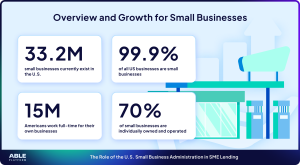
Small businesses are the bloodstream of the U.S. economy. Over 33 million SMEs in the USA give jobs to 61+ million Americans. Yet, according to the Bureau of Labor Statistics, over 24% of startups fail in their first year, with 48% of SMEs failing over the 5-year period.
That’s why support for U.S. small and medium-sized enterprises (SMEs) has become a matter of federal importance. One of the effective tools for access to finance among SMEs is the U.S. Small Business Administration (SBA) — an independent federal agency aimed at small business support.
SBA helps small businesses get funding, provides education for entrepreneurs, and links finance seekers with interested lenders. Here is a review of the SBA loan benefits for lenders and borrowers, the principles of SBA operations, and a unique business opportunity to expand the service range and increase customer outreach by becoming an SBA partner for lending businesses. We also introduce the ABLE™ SME lending software as a tried and tested option for gaining a competitive advantage in the lending market.
The lending market landscape continues to be dominated by small firms and enterprises. The recent SBA statistics reveal $410 billion in loans to small firms below $1 million; the size of outstanding consumer loans to small enterprises has exceeded $4 trillion thus far. Yet, the present-day unmet credit demand stands at $100+ billion, with many traditional banks reluctant to issue small loans to SMEs.
This is where new market players, such as FinTech firms, digital lending providers, and P2P lending platforms, come into play. The market size of digital lending only exceeded $2.1 billion in revenue in 2023, with the 2030 revenue forecast currently standing at over $10.4 billion. These tempos give us a growth rate of 25%+, which shows the rapid expansion of lending solutions’ use and popularity in the U.S.
These tech-savvy lending providers can play a key role in SME lending by partnering with borrowers via the SBA accreditation system. The market for SME financing offers incredible business opportunities, and this article examines the nuances of SBA small business loan servicing as a viable business idea for 2025.
SBA was founded in 1953 to protect the interests of small business owners across multiple aspects. Its creation was the culmination of almost two decades of the U.S. economy’s recovery from the Great Depression, which badly affected or destroyed thousands of SMEs. SBA formalized several pathways for federal support of small businesses in the U.S., including:
The main benefit of SBA’s operations for SMEs is its provision of alternative sources for accessing finance to stimulate SME-led economic development. The agency is focused on supporting SME survival and expansion because of the critical role of small business in job creation and the spread of innovation in the U.S. That’s why SBA has developed a number of loan guarantee programs of enormous value to:
The meaning of a loan guarantee is that these are government-backed loans. That’s why the risk for lenders is lower. The U.S. government will repay an estimated portion of the loan in case the borrower is unable to do so.
SBA’s support services are customized to various stages of a business lifecycle. Thus, a business owner can get essential help at the moment of launching a startup or when planning a market expansion.
The core role of SBA is to provide access to capital for small businesses that have exhausted other borrowing opportunities or have no access to them. Borrowers may choose from the three main types of SBA loans that match various business purposes:
Our next article outlines all of these SBA loan types, including their details, lender and borrower requirements, and financial specifications.
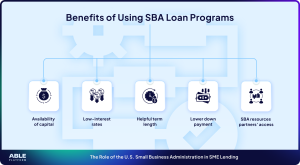
SBA financing is more accessible and flexible for small businesses. However, it also comes with specific downsides that an owner should weigh before applying for one of the SBA loan programs. Let’s take a closer look at the SBA loan advantages and disadvantages for borrowers.
The list of the key benefits of SBA loans is as follows:
The downsides of opting for an SBA business loan include:
Any lending business in the U.S. can apply to become an SBA lending partner. This partnership comes with many advantages for lenders:
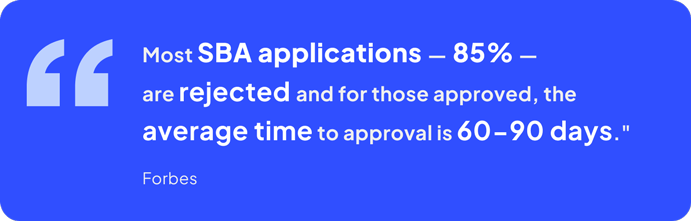
If you’re interested in this option, you may qualify as a Certified Lender Program (CLP) or Preferred Lender Program (PLP) participant. The main difference between these two categories is that CLPs are also authorized to service SBA loans, but their decisions also have to go through the SBA loan application process. So, it takes longer to get the loan disbursed because of the CLP and the SBA approval stages. PLPs can disburse loans without waiting for the SBA approval, so the process is generally faster. Yet, even CLPs make loans accessible within a shorter period compared to non-preferred and non-certified lenders working with SBA.
Most SMEs face the need to consider traditional bank loans vs. SBA loans in the process of seeking finance for their business operations. Here is the chart describing the main differences between these two financial options.
| Traditional loan | SBA loan | |
| Loan structure | Loans are fully funded by the bank or lending institution, with the lender carrying all the risk of non-repayment. | SBA doesn’t lend money on its own; it partners with accredited lenders to provide a portion of the loan. This way, lenders have more solid protections against non-repayment and risk a smaller sum. |
| Accessibility | To get a loan SMEs need a strong credit score, collateral, and an impressive financial record. | A lower credit score requirement. Even SMEs with a limited credit history can qualify. |
| Loan duration | 3–10 years for repayment. | 10 years for working capital, 25 years for real estate, up to 6 years for microloans. |
| Interest rates | Higher interest rates, especially for risky borrowers. | Low interest rates (often pegged to the prime rate). |
| Servicing fees | Origination and early repayment fees may be included. | Guarantee and servicing fees. |
Apart from the SBA approval badge, lending businesses can gain a greater competitive advantage in this growing, lucrative market niche by implementing robust, efficient SBA loan software for end-to-end automated loan underwriting. Our software can help any lender boost their business KPIs and efficiency, reduce delinquency rates, and improve the company’s overall financial health.
The ABLE™ Platform is a provider of safe, feature-rich small business loan origination software that can transform all aspects of your lending and loan servicing operations. Its unique competitive advantages in the market for SBA loan software include:
Due to these features and the speed of implementation, ABLE™ can be justly regarded as one of the best loan origination software for small business.
Small business is the most important and the most vulnerable part of the U.S. economy. With the digital lending industry experiencing unprecedented growth and digital transformation today, you can also supercharge your lending business by exploring automation solutions and stepping on the SBA partnership path.
The use of SBA loan servicing software, such as that supplied by ABLE™, will speed up and automate all stages of lending. Our solution simplifies lending decisions and operations by reducing bad debt risks and improving borrower satisfaction. Thus, it’s your optimal option to enter the SBA partner list with safe, transparent, and fast lending services.